There’s something heightening about an experience which you have no expectations for. It beckons for childlike wonder as you approach the unknown. This is the state I found myself in as I reached the Raymond James Stadium to watch the Buccaneers play against the Falcons. I hadn’t anticipated being moved by a football game of all things—something I had seen dozens of times before on TV—and I drastically undervalued what it would be like to sit in a stadium higher than I could fathom (equipped with a 100-foot pirate ship), or how it would feel to sit along with 60,000 other people all cheering for the same thing.
To have you understand my experience in its fullest, I need to admit that I was in a unique position. Unlike my most recent trips in which I planned and researched a majority of the details, I hadn’t done a thing to orchestrate our arrival, lodging, or entertainment. Aside from helping with the Uber, I was along for the ride, which was a very relaxed state to be in. Despite my hangover and the motion sickness from the ride over, I felt privileged when I sat down in that red stadium chair.
Two years ago my partner became seriously involved in watching football. It was a great inlet for making small-talk, providing the casual “Great game last night” to whichever team-winning-jersey person walked down the street. More intimately, it fueled conversation with relatives she had less in common with. Football was also a great excuse to hang out at the bar with her dad, not that we need a reason to waste a day in the local watering-hole. When he gifted the three of us tickets to watch her favorite team play, we were all pretty excited.
This wasn’t our first professional sporting event (we had seen a baseball game together years prior), but it was our first time watching football in which the players were only a couple yards ahead of us instead of on a screen. The field itself looked small, either in comparison to the huge stadium surrounding it or because every high school in America has a football field the same size and I’ve seen it before in less extraordinary conditions. Either way, I was struck by how close we were.
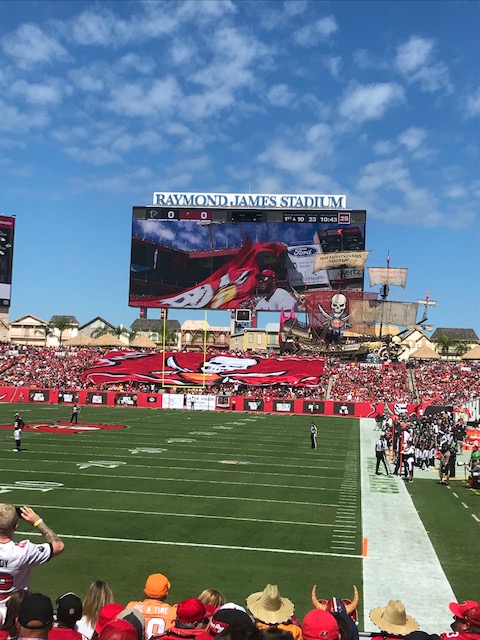
A giant screen stood at the other side of the field above the endzone and on it was a countdown leading to game time. When we sat down there was roughly sixteen minutes left. A handful of players from the opposing team rushed to the endzone close to us and fell to their knees. They extended out their arms, and it took me a moment to realize that they were praying. I wondered what prayers from someone at that level sounded like. If they asked for safety from injury, guidance to help them perform at their best, or simply for a winning score.
A few minutes prior to game-time the cheerleaders were introduced in enthusiastic fashion. A couple dozen women and men ran onto the field and were received with great cheer. Their steps seemed to bounce, as if all that excitement ricocheted off them and into the ground, giving them a little extra air. The women waved pom poms and the men held a small towel in one hand, twirling it around. They all appeared genuinely excited to be there.
At some point prior to the game starting a picture of a young man wearing a police uniform came onto the screen. He was a 21-year old deputy sheriff who had been killed in the line of duty earlier that week. An announcer requested a moment of silence. It’s a chilling encounter when over 60,000 people quiet themselves all at once. I was immediately moved by the respect shown. It made me realize the influence of numbers— at how much power is held in mass. I thought of mega-churches and wondered at how commanding that must feel: when thousands of people join together in prayer for the same cause. The high from adrenaline alone would be reason to go back every Sunday. Too bad I’m not a proponent of organized religion.
It became apparent that this whole game was more than just football. Or, perhaps football is more than just a game. I couldn’t deny the community aspect that was encouraged at every turn by the organization and then repeated back by the fans. Kelly, a local goal-beater, was recognized for surviving breast cancer. Her story was shared on screen and then the camera panned to her at the game, sitting among us and waving. The fan in front of me clapped his hands and cheered out, “Go Kelly.”
Members of the Coast Guard were present and their services recognized for the help they gave during hurricane Ian. In the wake of this natural disaster, footage of staff members from both teams were put on screen sending comfort packages to those affected. The COO of the Bucs team lent his voice to support the community as footage rolled of smiling fans from all ages holding up jerseys and other items.
It turned out that earlier that day the team foundation had hosted its 10th annual “Treasure Chests 5k” run raising $40-thousand dollars to support the fight against breast cancer. During half-time the runners of the race were invited onto the field, their shirts reading “We Keep Going” as they all joined in holding the team flag. Another fan who had beat breast cancer appeared on screen. As she shared her story one of her comments resonated with me, “I had my husband, son, and my team, the Buccaneers, to keep me going.”
This type of influence isn’t exactly foreign to me. After my twin sister survived a bone-marrow transplant in Boston (a necessary procedure in her battle with Leukemia), my mother started watching the Red Sox. One of my few good memories from that time was her staying up past midnight to see them win the world series, breaking the Bambino curse. For a moment there was excitement in our house that didn’t revolve around suffering and death.
Perhaps that’s why I’m so sensitive to the relationship between sport and community. To see that support from the team recognized so graciously, I wasn’t expecting it. At each turn of positivity, my heart clenched and I nearly let my eyes water.
Of course, this was a human experience. For the sake of balancing my reflection, I’ll share that I did witness some negativity, though it was very minor. When those players came to our endzone to pray, a fan did “Boo” at them (though I think that had more to do with them being from the opposing team than their expressing religion), and another frustrated fan yelled “Do your jobs” during a tense moment. The referees also didn’t have it easy, as every time they delivered a call against our team the crowd yelled, but I have to imagine they’re well used to it.
All of this was outweighed by the happiness surrounding me. I won’t forget the man a few rows ahead of me, holding his sleeping four-year old daughter, smiling ear-to-ear as if in love with the lot life gave him. The people in the stands were all about the positive interaction, and I realized that the stadium functioned as one of the few acceptable places in society for people to express themselves with wild, unleashed, enthusiasm. People could clap, yell, and chant, and such expressions were encouraged, even rewarded with free football-shaped-beaded necklaces and t-shirts.
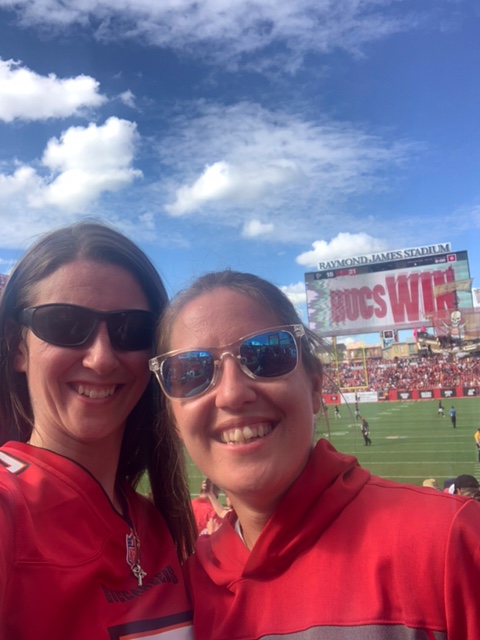
It also helped that the Buccaneers won. Something tells me that even if they lost, the fans around me would have been just as polite and considerate when navigating through the crowd out of the stadium and into the street. Maybe they were all feeling similar to me: a settling ecstasy that lasted into the night.

 KD Rye